
Renovations at Platteville Municipal Auditorium
 Renovations begin with the seating
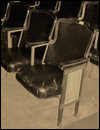
The Friends of Platteville Municipal Auditorium renovations started with the original 1928 seating on the main floor of the auditorium.
The original dark wood, black leather and metal frames had served well through the years, but by 2011 many of the hinges had broken, bolts had become loose from the floor making the chairs unstable, leather was badly cracked and the wood veneer was peeling off. Rows in the front center had harder use and broken down completely. They were no longer safe and had been removed.
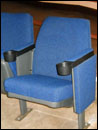
Furthermore, current users were used to modern seating which is roomier, padded and has wider rows for accessibility. Tall patrons had no room for their legs. The older, narrower, harder seating was uncomfortable and elicited a lot of shifting around during performances. Sightlines were compromised because chairs were arranged directly behind one another instead of staggered to give patrons an unobstructed view of the stage. Side sections were aimed straight ahead instead of angled toward the stage, forcing patrons to sit with their heads turned for the entire duration of an event.
 Enter State Theatres LLC, an area business with a number of cinema theatres in the
tri-states. They offered to contribute gently used cinema
chairs, transport and install them if the Friends would remove the old chairs
and help unload the new. The Friends happily agreed. They supported State
Theatres and their various fund drives to raise the necessary money to purchase
the seating.
Enter State Theatres LLC, an area business with a number of cinema theatres in the
tri-states. They offered to contribute gently used cinema
chairs, transport and install them if the Friends would remove the old chairs
and help unload the new. The Friends happily agreed. They supported State
Theatres and their various fund drives to raise the necessary money to purchase
the seating.
Seat removal began on June 20, 2011.
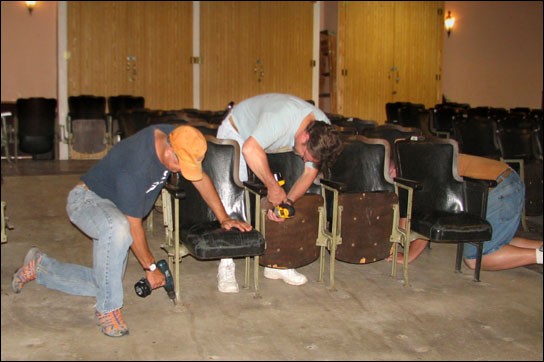
Volunteers brought their own equipment: a 3/8 inch reversible electric drill with a standard screwdriver bit,
a 3/8 inch reversible angle drill, and a grinder. The process was awkward,
tedious and dirty. Electrical connections which lit the
aisle chairs were disconnected. Screws were removed from the seat backs and seat
cushions of the second, fourth or sixth chair to create sections. The
parts were then stacked against the walls.
The bolts fastening each section of chairs to the floor were removed, then each
section was stacked together in groups. Unused armrest stanchions were
unfastened from the floor and set aside. Any metal pieces remaining in the floor had to be ground off.
As seat sets became available, the Friends of the Platteville Municipal
Auditorium sold the old seats to raise money for the restoration. The old
seats were sold to the public "as is" in sections of 2, 4, 6 seats for $5 per
chair on a cash-and-carry basis. The auditorium was open June 26-29 and July 16
so that people could come, pick their seats and remove them. Volunteers from the
Friends helped with removal. Intended uses were varied, entry, den, family,
media room, Sunday school, storm shelter seating, and even a turn onstage
as play scenery. The Friends of PMA sold 135 seats and made $894.
 Seats not chosen were stripped for recyclable cast iron, a laborious process which involved
detaching unrecyclable parts from the iron. The cast iron was hauled to
Woodward Recycling, weighed in at 2700 pounds, and netted an additional $351 for
refurbishing. All leftover chair parts were discarded.
Seats not chosen were stripped for recyclable cast iron, a laborious process which involved
detaching unrecyclable parts from the iron. The cast iron was hauled to
Woodward Recycling, weighed in at 2700 pounds, and netted an additional $351 for
refurbishing. All leftover chair parts were discarded.
Floors were swept and cleaned, then the truck arrived from Ohio with the "gently used" seating. Over the course of several hours volunteers unloaded approximately 12,000 parts (the seat backs, cushions and armrest stanchions) and then stacked them along the perimeter of the auditorium. At this point, a professional installer came in and arranged the new wider seating in a gentle arc, allowing patrons to view the stage without straining their necks. Seats were offset to allow for better sightlines. Rows were set further apart, giving people better accessibility and more leg room. Open spaces were left in the rows for wheelchair-bound patrons.
Extra chair parts were stored, upholstery was cleaned, the floors swept and the auditorium tidied to complete the project.
The first event held in the auditorium after the new seating was installed was Platteville playwright Mike Willis' memorial play 'The Eleventh', staged on September 11, 2011 by the Platteville Community Theatre. Friends of PMA president Cheryl Schmieder noted the new seating to appreciative applause. A free-will donation was taken on behalf of the Friends of PMA and brought in $744.
Between the cost of the seating, installation, removal/cleanup labor and related expenses, $59,600 worth of real and "in-kind" money was spent on the project.
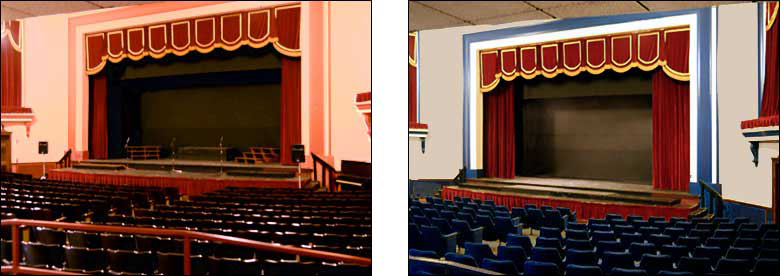
Coordinating paint applied
 The second project involved covering the 1980s orange with terracotta trim
paint.
The second project involved covering the 1980s orange with terracotta trim
paint.
The existing paint was dirty and in poor shape. It had been banged up. Areas were peeling. Fire alarm modifications to the walls with no extra cans of color to finish the repair led to unpainted patchwork. The paint looked like it had been serving patrons over thirty years.
Colors were chosen to coordinate with the cobalt blue color of the new seats and existing rich red stage curtains. (The curtains were installed for $20,000 at the urging of the Platteville Community Theatre prior to the state-wide Wisconsin Association of Community Theatres contest and festival in 2003.) Color choices of a cobalt blue, warm beige and eggshell white were suggested to the Common Council by the Friends of the PMA and approved. The ceiling was to remain unpainted, as was the wood trim.
Painting was started by Rock Church Construction of Livingston, Wisconsin on April 16th of 2012 with the patching of damaged plaster. It completed in May 2012 for $16,000. It was funded partly by the Robert and Marian Graham Fund and partly by matching funding from the Friends of Platteville Municipal Auditorium.
The first event held in the auditorium after the painting was completed was a civic event, the Memorial Day observance of 2012, hosted by the VFW and American Legion.
Sound System installed
When the auditorium was built movies with sound were brand new. 'The Jazz Singer' had been released the previous year and "audio equipment" in most movie theatres consisted of a piano. Music was always performed live, and the Municipal Auditorium was better than many area venues at providing accompaniment for those onstage with its discrete (and tiny) orchestra pit. Live performers onstage used vocal projection to get their voices across to their audience. Amplification didn't enter the picture at all.
With the passage of time, amplified sound (films with audio tracks, microphones for lecturers, pre-recorded music and sound effects) was eventually used in the auditorium, but amplifiers had to be brought in.
Platteville Community Theatre started with a 1980s era "boom box" for pre-recorded sound. They gradually added better equipment while keeping the unit small and mobile so that their sound system could remain portable for AACT-Fest contests around the region. Eventually, large permanent Peavey home speakers were added to the balcony railing, but they were hard pressed to keep up with the needs of modern productions. The necessary wiring was bundled, then taped to floors, walls, poles, and railings so people wouldn't trip over them.
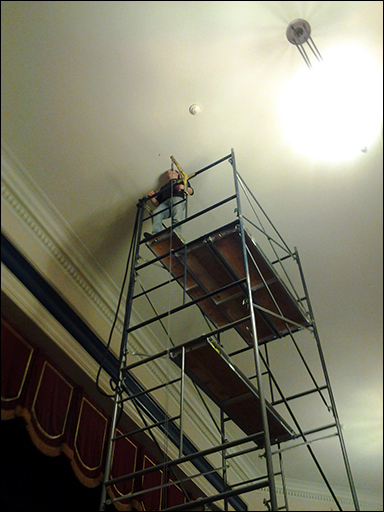
After preliminary electrical wiring was completed by Al Otto of Al's Electric, the new sound system was installed in October 2013 by Lifeline AV Technologies under the design and direction of Scott Wright. Others involved in the installation of the audio equipment included the auditorium tech director Dick Davies and Bernie Millage of Lifeline.
Four Renkus Heinz speakers suspended 25 feet off the floor provide coverage for the main seating area. A subwoofer was mounted in the center of the proscenium opening just in front of the stage for deeper frequencies. Two portable monitors were also included in the design. The mix is run from the 24-channel Allen and Heath board in the sound booth. A patch bay was added to allow patch inputs between the main mixer and a stage mixer. Inputs include spots for overhead mics, wireless body microphones, four handheld mics, and computer audio. Offstage racks house amplifiers, digital signal processors, power sequencers, a CD player and an i-Pod.
Although the basics of an excellent audio system are now available, there is still a dire need for microphones and related equipment. Until it can be purchased for the auditorium, Lifeline has this equipment available for rent.
The installation of the sound system cost $62,000 total, including a substantial donation from Lifeline. Other significant contributors were the Robert and Marian Graham Fund, Platteville Arts Board, Prudential Insurance Company and the Friends of Platteville Municipal Auditorium. The general public also helped with donations and attendance at fundraising events.
One of the first events that utilized the new sound system was the 2013 Veterans Day concert given in tribute to area service vets by Ken Kilian's Classic Big Band. Later, a bluegrass concert featuring two nationally award winning bands, Lonesome River Band and the Bluegrass Express also took advantage of the auditorium's new audio capabilities.
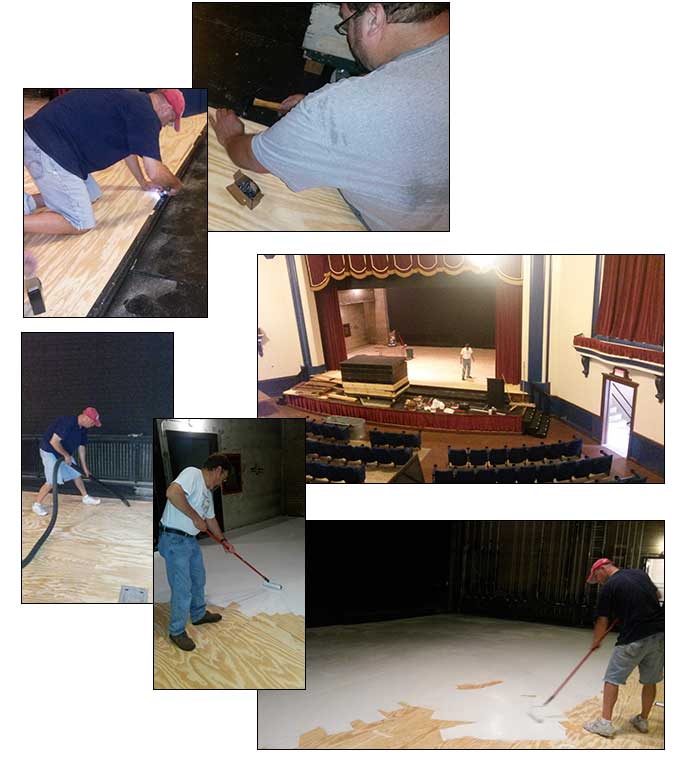
Stage Floor resurfaced
Like the rest of the auditorium, the softwood stage floor had served a very long
time. Toward the end of its 86 year lifespan, it was extremely uneven, creaky
to the point of drowning out onstage dialogue, and the deep ruts on the surface
had been known to trip actors and dancers in the midst of performing.
Long-gone scenery fastened to the floor left nails and screws broken
off in the wood, making sanding it smooth impossible. Furthermore, simply
digging up the floor and replacing it with new floor boards meant dealing with fire codes
that would require massive electrical changes in the dressing rooms below.
The later was impractical, given the limited resources of the group.
Thanks to donations from an anonymous benefactor, the Platteville Community Theatre,
and the Southwest Academy of Ballet Arts, the stage was
resurfaced with thick plywood in September of 2014 for about $1500.
The first step was to clear the area of many of the items stored back
stage. Volunteers from the Friends of Platteville Municipal Auditorium,
Southwest Academy of Ballet Arts, Platteville Community Theatre and Rolling
Hills Church joined forces for this task. The volunteer construction crew
got busy hauling plywood and supplies, then began laying down the new floor in
mid September. Puttying followed. Principally involved were Dick Davies,
Mike Schmieder, Mike Humke, and William Miller. Completion of laying the floor was on
September 20th. A primer coat preceded black satin paint to finish the
job.
Although Rolling Hills Church, Ken Kilian's Classic Big Band and the cast of the Tri-State Homeschooler's play
'Narnia: The Lion, the Witch and the Wardrobe' used the new flooring first, the
most grateful beneficiary was
probably the cast of Southwest Academy of Ballet Arts' 'The Nutcracker', performed in December of 2014.


